Details
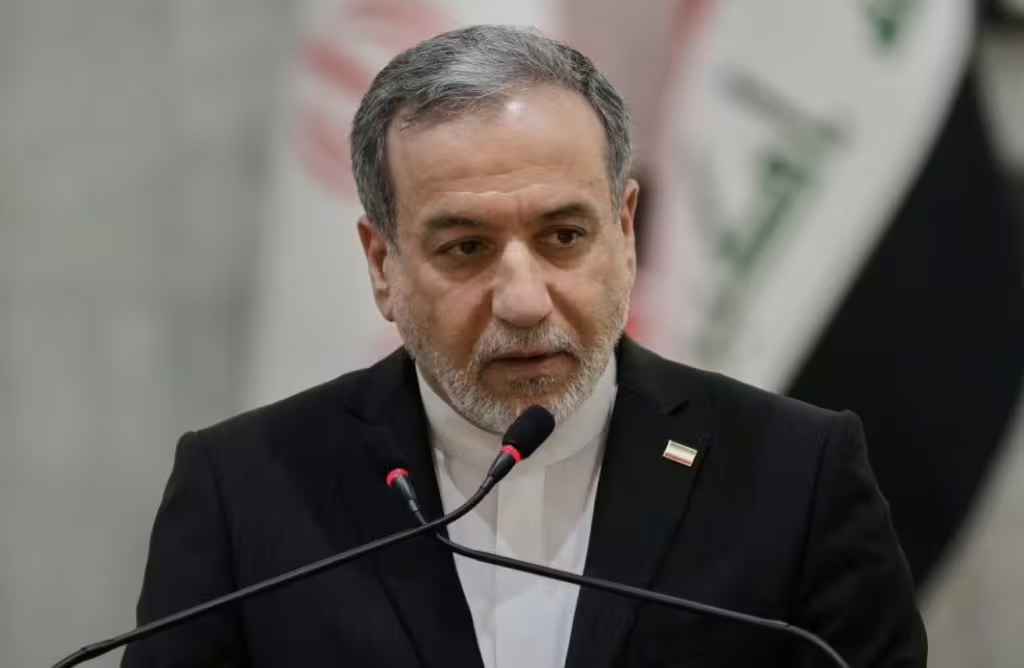
- The Wall Street Journal said Iranian Foreign Minister Abbas Araghchi declared that the management and full restoration of maritime traffic in the Strait of Hormuz is Iran’s responsibility.
- Araghchi said, according to Iranian state media, that no other country or entity has responsibility or authority over the matter.
- His comments represent one of Tehran’s clearest public interpretations of the preliminary agreement with Trump, with Iran arguing that the deal gives it authority over the reopening and administration of the strait.
- That interpretation conflicts with the U.S. position, which holds that the agreement does not give Iran control over the international waterway and that navigation through Hormuz must remain unimpeded.
- The Iranian position followed several days of back-and-forth strikes between Tehran and Washington, which began after Iran attacked a ship attempting to cross the strait close to Oman’s coastline.
- Iran wants commercial vessels to use a separate route closer to its own coastline and had warned ships against using the Omani route.
- Ali Vaez, Iran project director at the International Crisis Group, said Tehran has little interest in seeing its leverage erode as more ships are rerouted through Omani waters.
- The fighting has unsettled shipowners and cast doubt over the reopening of the waterway, which is the central achievement of Trump’s preliminary deal with Iran.
- The agreement was designed to restore traffic through Hormuz while pushing more contentious issues, including Iran’s nuclear program, into a second phase of negotiations.
- Those talks were expected to resume in Switzerland over the weekend, but they have been stalled by the fighting, according to people familiar with the matter.
- The deal signed earlier in June assigns Iran responsibility for making arrangements for the safe passage of commercial vessels.
- It also says Iran, in consultation with other regional parties, will determine future terms for administration and maritime services in the strait.
- At the same time, the agreement says military obstacles should be removed and maritime traffic should resume immediately.
- U.S. Ambassador to the United Nations Mike Waltz said Washington would not tolerate further attacks on ships.
- Speaking to Fox News, Waltz said Iran would be mistaken if it believed Trump would stand by while Tehran continued to attack international shipping or U.S. bases without a response.
- In recent days, Iran struck two vessels, including a containership and a tanker carrying oil from Qatar, one of the mediators in the U.S.-Iran talks.
- The United States responded with attacks on Iranian communications, drone and missile sites along the Hormuz coast.
- Iran later attacked targets in Kuwait and Bahrain, widening the scope of the confrontation around the Gulf.
- Mohamed Amersi, an Iran expert and member of the Wilson Center’s Global Advisory Council, said the United States is testing Iran’s resolve, while describing the escalation so far as managed.
- The Wall Street Journal said Iran effectively closed the strait early in the war by attacking ships.
- Although the U.S. military has escorted several vessels through the chokepoint, it has struggled to deprive Iran of the ability to threaten shipping.
- Maritime traffic remains at a fraction of prewar levels, when around one-fifth of global oil flows moved through the Strait of Hormuz.
- Despite repeated U.S. strikes on sites along the Hormuz coast, Iran has continued to demonstrate that it can hit vessels when it chooses to escalate.
What’s next?
The central dispute now is over the meaning of the preliminary agreement itself: whether it gives Iran a limited role in arranging the reopening of the strait, or something closer to practical authority over maritime traffic.
If Tehran continues to impose preferred routes on vessels, and Washington responds militarily to each attack, Hormuz could shift from a ceasefire mechanism into a recurring flashpoint.
If talks resume in Switzerland, the administration of the strait will be the first major test of whether the agreement can survive before the two sides move to more difficult files, especially Iran’s nuclear program.