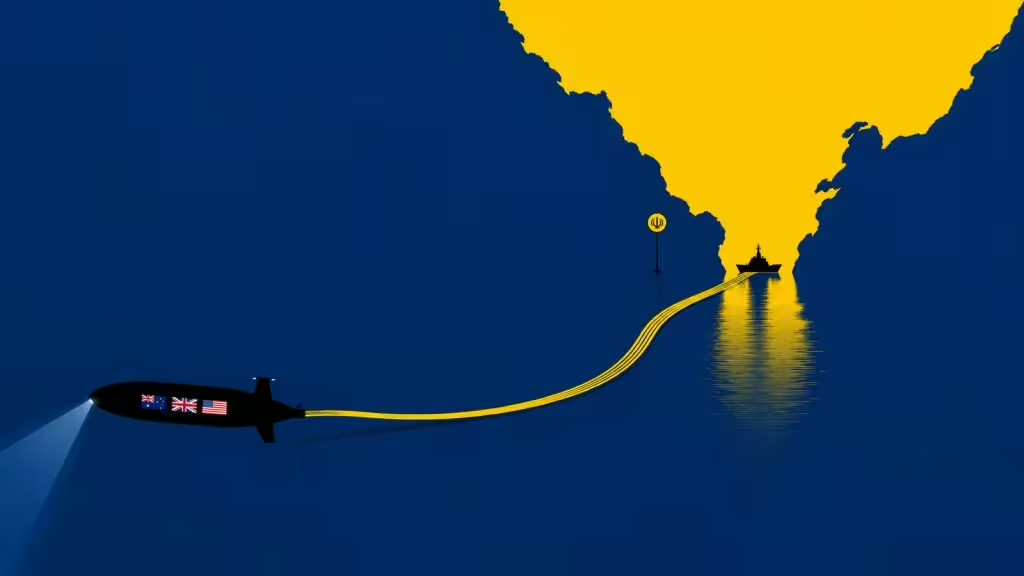
Undersea cables are increasingly viewed as one of the global economy’s most vulnerable assets, prompting AUKUS partners to launch a new program focused on protecting critical infrastructure on the ocean floor.
Australia, the United Kingdom, and the United States announced plans to develop advanced unmanned underwater systems, with deliveries expected to begin in 2027. The platforms will be used to monitor subsea cables and pipelines, conduct surveillance missions, detect threats, and support anti-submarine operations.
UK Defence Secretary John Healey said protecting seabed infrastructure has become an increasingly important security priority as risks to undersea communications and energy networks continue to grow.
Details
• The initiative follows a series of incidents involving undersea cables in regions including the Red Sea and the Baltic Sea, raising concerns about sabotage and deliberate attacks on critical infrastructure.
• International estimates indicate that more than 95% of cross-border communications and data traffic travel through undersea cables, including a significant share of daily global financial transactions.
• Washington, London, and Canberra view autonomous maritime systems as a more efficient and cost-effective way to monitor thousands of kilometers of submerged cables and infrastructure than traditional naval patrols.
• At the same time, the Strait of Hormuz is gaining strategic importance beyond its traditional role as a key oil and gas transit route, emerging as a major hub for global digital data flows.
• Recent estimates suggest that roughly one-fifth of global data and financial communications traffic passes through cable networks linked to the Hormuz region.
• In recent months, Iranian officials and media outlets close to the Islamic Revolutionary Guard Corps have floated proposals to impose transit fees or licensing requirements on cables crossing the strait, while requiring operators to comply with Iranian regulations.
• The affected cable networks support major global technology companies, fueling concerns that Hormuz could become a geopolitical pressure point extending beyond energy markets into the digital economy.
What to Watch
Competition among major powers is increasingly moving beneath the surface. As undersea cables become central to national security and the global digital economy, Western efforts to secure critical infrastructure are accelerating. At the same time, Iran’s discussion of new rules for cables crossing Hormuz could turn digital connectivity into a strategic flashpoint alongside traditional energy routes.