Details
Less than 24 hours after Lebanon and Israel signed a U.S.-brokered framework agreement in Washington, Lebanon was already showing signs of deep internal polarization, with protests in Beirut and growing fears that political tensions could spill into domestic conflict.
The agreement marks the most significant political and security framework between the two countries in decades. It aims to turn the fragile ceasefire into a pathway toward longer-term security arrangements under U.S. supervision and with international backing.
Under the framework, the Lebanese Armed Forces would gradually assume control over all Lebanese territory while non-state armed groups would be disarmed and their military infrastructure dismantled. In return, Israel would carry out a phased withdrawal from parts of southern Lebanon, and both sides would establish a U.S.-supervised military coordination mechanism.
The central obstacle is Hezbollah’s outright rejection of the sequencing. The group refuses to tie any Israeli withdrawal to the surrender of its weapons, arguing that its arsenal remains essential to what it calls its resistance against Israel.
In his first official response, Hezbollah Secretary-General Naim Qassem declared the agreement “null and void,” accusing the Lebanese government of surrendering the country’s sovereignty and pledging that Hezbollah would continue its armed resistance.
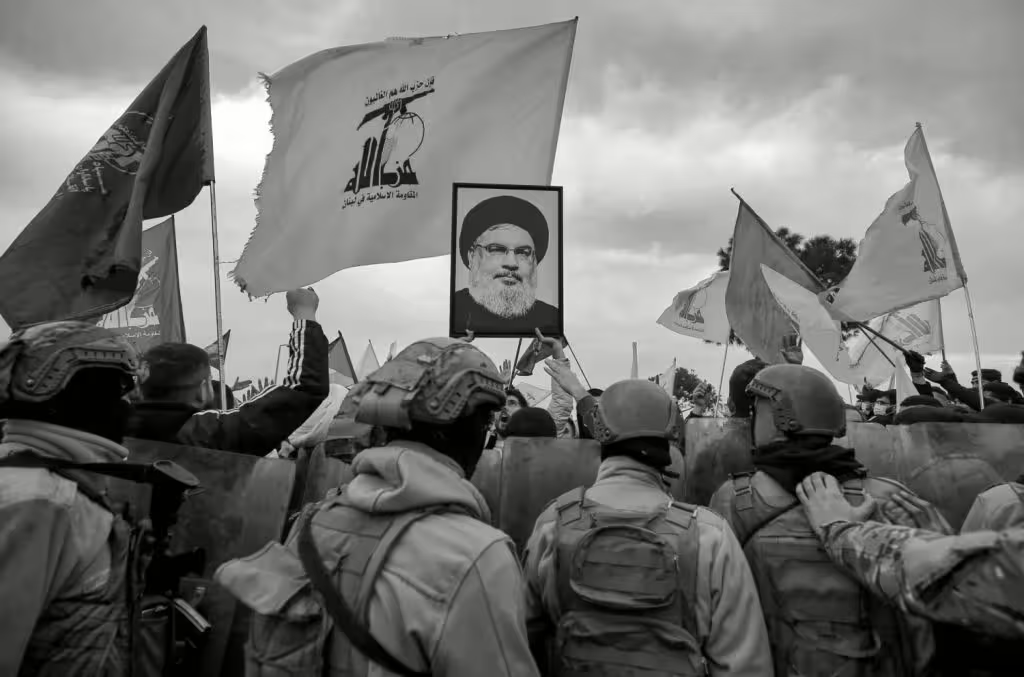
Hours after the announcement, demonstrators—many carrying Hezbollah flags—blocked roads, burned tires, and gathered near government buildings in Beirut, underscoring the scale of the domestic divide.
Parliament Speaker Nabih Berri sought to calm tensions, warning Lebanese citizens against what he described as “sedition” and urging restraint to prevent political disagreements from turning into internal confrontation.
President Joseph Aoun, meanwhile, strongly defended the agreement, calling it the first step toward restoring Lebanon’s full sovereignty and enabling displaced residents to return to the south.
Washington also pledged to support implementation through a joint military coordination mechanism, while Secretary of State Marco Rubio announced an immediate $100 million humanitarian aid package and broader international efforts to help rebuild Lebanon’s economy.
Despite the diplomatic breakthrough, violence has not fully subsided. Lebanon’s state news agency reported that an Israeli drone strike targeted an area in southern Lebanon just hours after the agreement was announced, highlighting the fragility of the situation.
Background
The latest agreement follows months of cross-border fighting between Israel and Hezbollah that escalated sharply in March. Previous ceasefire efforts failed to halt the violence, which has killed thousands, displaced more than one million people inside Lebanon, and deepened the country’s political and economic crisis.
Over recent months, the United States has pushed for a framework that expands the Lebanese army’s role in the south while gradually reducing Hezbollah’s military presence as the foundation for a longer-term settlement. Hezbollah, however, has consistently rejected any proposal that conditions Israeli withdrawal on its disarmament.
Analysts say the agreement now tests two critical questions: whether the Lebanese state can reassert authority in the south, and whether Hezbollah is willing to accept a reduced military role. The answers are likely to determine Lebanon’s stability in the months ahead.
What to watch
The agreement’s success will depend on whether U.S. mediators can keep both sides committed during its early implementation. Israel’s willingness to proceed with a phased withdrawal and Beirut’s ability to carry out its commitments despite Hezbollah’s opposition will determine whether the framework becomes the foundation for lasting stability—or another failed diplomatic effort.