The latest
While global attention remained fixed on President Donald Trump’s statements and developments surrounding Iran, a potentially far more consequential strategic development unfolded in Houston.
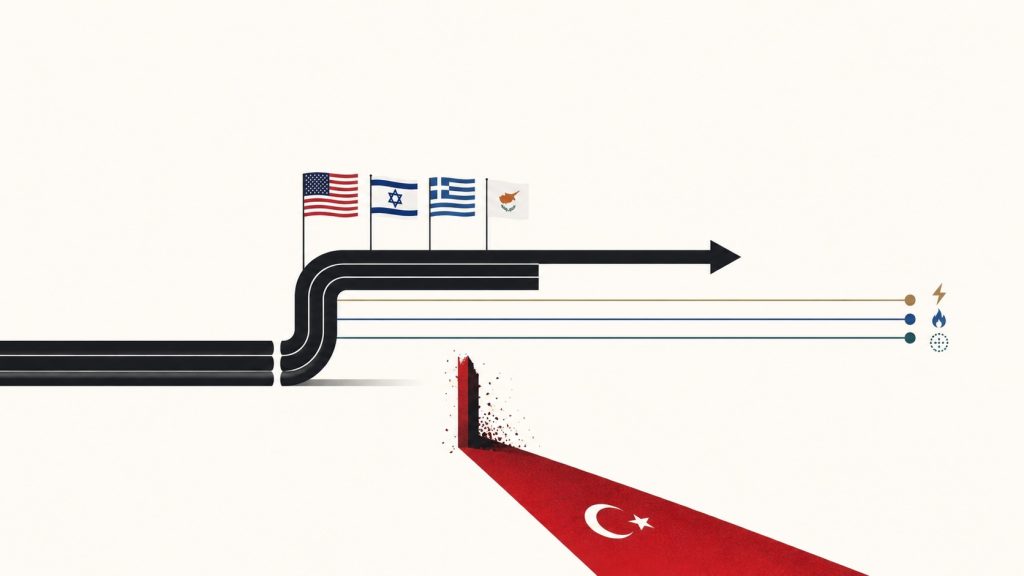
Representatives of the United States, Israel, Greece and Cyprus signed an agreement establishing the Eastern Mediterranean Energy Center (EMEC) during an event hosted by Rice University’s Baker Institute for Public Policy.
The center is designed to coordinate joint efforts in research, cybersecurity and the protection of critical energy infrastructure under the framework of the 3+1 partnership that brings together Washington, Israel, Greece and Cyprus.
Details
• Although presented as a research and technology initiative, the center is widely viewed as a strategic building block for the western section of the India-Middle East-Europe Economic Corridor (IMEC).
• Israel is expected to serve as the eastern gateway of the project, connecting energy, data and logistics networks flowing from the Gulf and Asia toward Europe.
• Cyprus is positioned as the project’s maritime anchor, with a central role in subsea cable projects and the development of shared gas resources.
• Greece is expected to function as the main entry point for Middle Eastern energy and infrastructure into the European Union.
• The development comes as Turkey continues to pursue its goal of becoming Europe’s dominant energy transit hub and advances its “Blue Homeland” doctrine, which has fueled maritime disputes with Greece and Cyprus.
• The emerging route could also reduce reliance on traditional pathways linked to Egypt and the Suez Canal by creating a more diversified regional energy and transport network.
• The initiative builds on years of expanding security and defense cooperation among Israel, Greece and Cyprus, including military exercises, defense agreements and major procurement programs.
What to watch
The project’s significance lies in its direct U.S. backing. By establishing the center on American soil and participating in its creation, Washington is signaling support for a new regional architecture centered on the Israel-Greece-Cyprus axis.
If successfully developed, the framework could reshape energy flows, infrastructure investment and strategic influence across the Eastern Mediterranean and Europe, while increasing pressure on Turkey’s regional ambitions.